
Every conversation about AI in customer service starts with tone and ends with tone. Does it sound human, is it too formal, does it use the right words.
Tone is the least of it. The failure that actually costs a business is an answer that was invented: a return window that does not exist, an availability that was never checked, a price from a catalogue the model never saw. It arrives in fluent, confident prose, and the customer has no way to tell it apart from a true one.
AI agents must refuse when uncertain. This is not a failure but a strategic necessity. An AI agent that confidently provides incorrect information can damage trust and lead to costly errors. Grounding responses in verified data is essential: when information is missing, refusal is the correct approach. Imagine an AI booking a flight without confirming availability or issuing a refund without authorization. These errors can have significant financial implications. By the end of this article, you will understand why refusal is a critical feature of AI customer service, how it safeguards accuracy, and why it should be measured alongside resolutions.
Why AI Agents Must Refuse When Uncertain
Incorrect AI responses can significantly damage trust and incur costs. When AI agents provide confident but incorrect answers, the consequences can be severe. Customers rely on accurate information, and any deviation can lead to dissatisfaction and financial loss. Suppose a customer queries an AI agent about a product's availability. If the agent confidently confirms stock without verifying, only for the customer to later discover the product is unavailable, trust is eroded. Worse, if this misinformation leads to financial commitments, such as travel arrangements based on incorrect booking confirmations, the costs can escalate rapidly.
Refusal is better than misinformation. An AI agent that refuses to provide an answer when uncertain is not failing; it is protecting the integrity of the interaction. According to Frigade, AI agents should refuse when lacking sufficient information to ensure accuracy. This refusal is a safeguard, ensuring that only verified information is conveyed to customers. By prioritizing refusal over guesswork, businesses can maintain trust and avoid costly errors.
Consider the following comparison between refusal and misinformation:
| Scenario | Refusal Outcome | Misinformation Outcome |
|---|---|---|
| Product Availability Inquiry | "I do not know, let me check." | "Yes, it is available." (when it is not) |
| Refund Authorization | "I need to verify this with a colleague." | "Your refund is processed." (without basis) |
| Booking Confirmation | "I will confirm availability first." | "Your booking is confirmed." (incorrectly) |
In each scenario, the refusal outcome maintains the customer's trust and prevents potential financial repercussions. For instance, in a refund scenario, an AI agent that incorrectly processes a refund can lead to financial discrepancies and customer dissatisfaction. By refusing to act without confirmation, the agent ensures that all actions are grounded in verified data.
Measuring refusals alongside resolutions is crucial. An AI system that never refuses might seem efficient but could be unmonitored and prone to errors. It is essential to track refusals as a metric of the system's integrity. According to ITPro, many companies have had to reconsider their AI strategies due to issues like data exposure and hallucinations. These challenges highlight the importance of robust governance, where refusal is a critical component.
In summary, refusal is not a failure but a strategic necessity that protects both the customer and the business. By ensuring that AI agents refuse when uncertain, companies can safeguard accuracy, maintain trust, and avoid costly mistakes.
Implementing Grounding Techniques for AI Agents
Ensuring AI agents provide accurate responses is critical for maintaining trust and avoiding costly errors. Grounding techniques play a vital role in achieving this accuracy by preventing AI hallucinations. Grounding refers to the process of anchoring AI responses in verified data, ensuring that any information provided is based on factual and reliable sources.
Knowledge Grounding to Prevent Hallucinations
AI hallucinations occur when an agent generates information that is not supported by any real data. This can lead to misinformation and erode customer trust. Knowledge grounding is essential to prevent these hallucinations. By integrating AI with a comprehensive and verified knowledge base, responses can be aligned with actual data, reducing the risk of fabricating information.
Suppose an AI agent is tasked with providing information about product specifications. Without proper grounding, it might invent details, leading to customer dissatisfaction. By grounding the AI in a verified database containing accurate product information, the agent can ensure that its responses are both accurate and reliable.
Retrieval-Augmented Generation (RAG)
One of the most effective methods for knowledge grounding is Retrieval-Augmented Generation (RAG). RAG combines retrieval mechanisms with generative models to produce responses that are both informative and accurate. According to Inkeep, implementing RAG is crucial for preventing AI hallucinations and ensuring the accuracy of AI responses.
RAG works by retrieving relevant documents or data from a pre-defined knowledge base and using this information to generate responses. This ensures that the AI agent's answers are grounded in actual data, minimizing the risk of misinformation. Imagine an AI agent handling customer inquiries about return policies. By using RAG, the agent can retrieve the exact policy document and provide the customer with accurate information, rather than relying on potentially flawed memory or assumptions.
Framework for Implementing Grounding Techniques
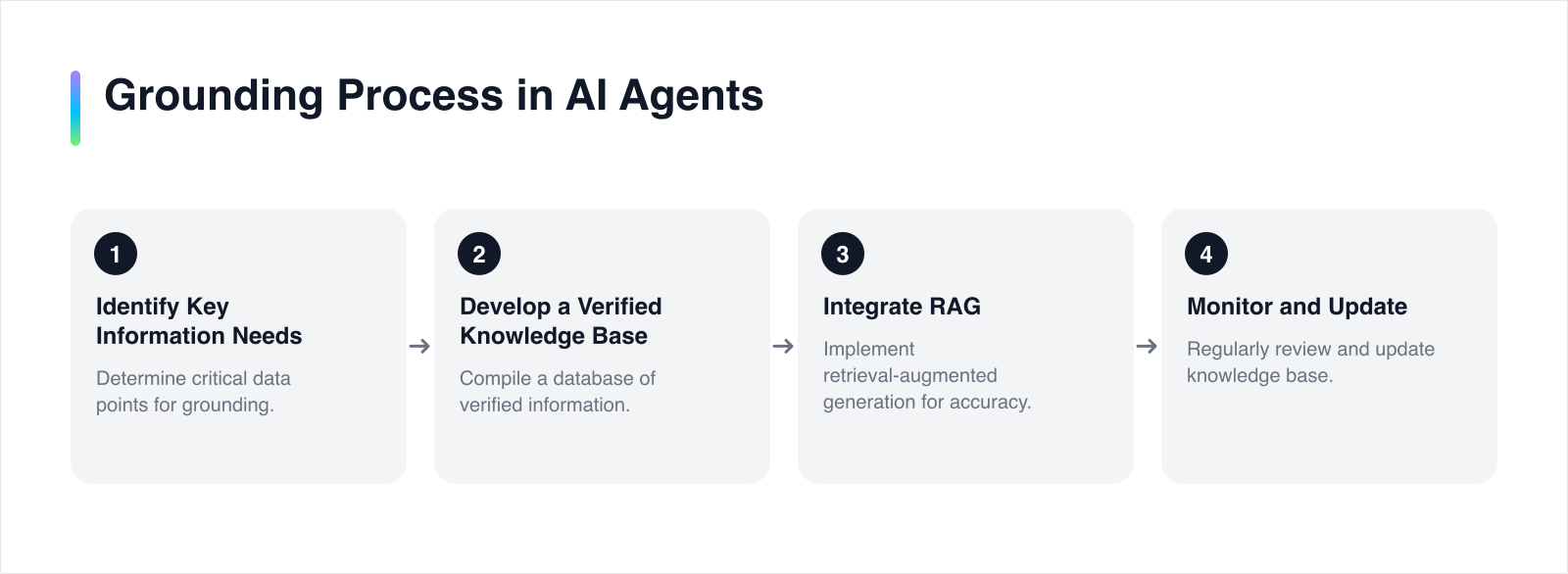
To effectively implement grounding techniques, businesses can follow a structured framework:
| Step | Description |
|---|---|
| 1 | Identify Key Information Needs: Determine the critical data points that require grounding. |
| 2 | Develop a Verified Knowledge Base: Compile a comprehensive database of verified information. |
| 3 | Integrate RAG: Implement retrieval-augmented generation to enhance response accuracy. |
| 4 | Monitor and Update: Regularly review and update the knowledge base to ensure ongoing accuracy. |
By following this framework, companies can ensure that their AI agents are equipped to provide accurate and reliable responses. This not only protects the integrity of customer interactions but also reduces the potential for costly errors.
In summary, grounding techniques such as knowledge grounding and RAG are essential for maintaining the accuracy of AI agents. By anchoring responses in verified data, businesses can safeguard trust and ensure that their AI systems contribute positively to customer service operations.
Developing a Refusal Policy for AI Systems
Creating a refusal policy for AI agents is essential to ensure that they operate within defined boundaries, maintaining accuracy and trust. A well-crafted policy outlines when and how AI agents should refuse requests, promoting consistent and explicit decision-making.
Defining Refusal Criteria
The first step in developing a refusal policy is to establish clear criteria for when an AI agent should refuse a request. This involves identifying scenarios where the agent lacks sufficient information or where compliance with business rules is required. For example, if an AI agent is unsure about a product's availability, it should refuse to confirm stock without verification. Similarly, requests that violate company policies must be declined, with the agent clearly stating the reason and offering alternative solutions.
According to Behavior Engineering, a refusal policy ensures that AI systems make consistent decisions by defining explicit boundaries. This prevents the AI from making assumptions that could lead to misinformation.
Ensuring Consistent Decision-Making
Consistency in decision-making is crucial for maintaining customer trust. A refusal policy should include guidelines for how AI agents communicate refusals. This involves using standardized language to explain why a request cannot be fulfilled and what steps will be taken next. For instance, an AI agent might say, "I cannot confirm this information at the moment. Let me connect you with a human agent for further assistance."
To ensure consistency, businesses can implement a checklist that AI agents follow when determining whether to refuse a request:
| Step | Description |
|---|---|
| 1 | Assess Information Availability: Determine if the necessary data is present to fulfill the request. |
| 2 | Check Policy Compliance: Verify if the request aligns with established business rules. |
| 3 | Communicate Clearly: Use standardized language to explain the refusal and next steps. |
| 4 | Offer Alternatives: Provide legitimate paths to address the customer's needs. |
Implementation and Monitoring
Once the refusal policy is developed, it must be implemented across all AI systems. This involves training AI agents to recognize refusal scenarios and adhere to the established guidelines. Regular monitoring and updates to the policy are essential to adapt to changing business needs and regulations.
Suppose a company launches a new product line. The refusal policy must be updated to include scenarios specific to this product, ensuring AI agents can handle related inquiries accurately.
By developing and implementing a robust refusal policy, businesses can safeguard the integrity of their AI systems. This not only enhances customer trust but also prevents costly errors that can arise from misinformation.
Escalation Strategies: When AI Should Hand Off to Humans
AI agents are powerful tools for handling routine customer service inquiries, but there are situations where human intervention is necessary. Complex or high-risk scenarios often require the nuanced understanding and decision-making capabilities that only human agents can provide. Escalation is not just a fallback but a vital component of a robust refusal strategy, ensuring that customer service remains accurate and trustworthy.
Complex and High-Risk Situations
AI agents excel at managing straightforward tasks, but they can struggle with complex or high-risk situations. These include issues involving emotional sensitivity, regulatory compliance, or intricate problem-solving. For example, handling a complaint about a defective product that requires a detailed understanding of warranty terms might be beyond the AI's capabilities. In such cases, escalation to a human agent is essential to provide the customer with a satisfactory resolution.
According to CellCog, AI agents should escalate when they encounter scenarios that exceed their programmed capabilities. This could include requests that involve sensitive data or require discretion in decision-making, ensuring that the customer's needs are met without compromising service quality.
Decision Matrix for Escalation
A decision matrix can help determine when an AI agent should escalate an issue to a human. This tool evaluates the complexity and risk associated with a request, guiding the AI in making consistent and effective escalation decisions. The matrix considers factors such as data availability, emotional context, and compliance requirements.
| Factor | AI Handles | Requires Escalation |
|---|---|---|
| Data Availability | Complete | Incomplete |
| Emotional Sensitivity | Low | High |
| Compliance Needs | Standard | Complex |
| Problem Complexity | Simple | High |
For instance, if a customer inquiry involves incomplete data or high emotional sensitivity, the matrix would guide the AI to escalate the issue. This structured approach ensures that AI agents make informed decisions, maintaining service quality and customer satisfaction.
Integrating Escalation into Refusal Strategies
Incorporating escalation into refusal strategies enhances the overall customer service framework. When an AI agent refuses to handle a request due to uncertainty or complexity, it should smoothly transition the inquiry to a human agent. This integration ensures that refusals do not lead to dead ends but instead direct customers toward solutions.
Suppose a customer contacts an AI agent with a question about a complex billing issue. If the AI lacks the necessary information to resolve the query, it should refuse to provide an answer and escalate the issue to a human agent who can offer a detailed explanation and resolution. This approach not only preserves customer trust but also ensures that the service remains efficient and effective.
In summary, escalation is a critical element of a comprehensive refusal strategy. By recognizing when to hand off complex or high-risk situations to human agents, businesses can maintain high standards of customer service while using AI's strengths. Implementing a decision matrix further supports AI agents in making consistent and informed escalation decisions, ultimately enhancing the customer experience.
Measuring and Monitoring AI Refusal Rates
Tracking and analyzing AI refusal rates is crucial for understanding the effectiveness of AI systems in customer service. By measuring these rates alongside resolution rates, businesses can gain insights into the balance between accuracy and customer satisfaction.
Tracking Refusal and Resolution Rates
To effectively measure AI refusal rates, companies should implement a system that tracks both refusals and resolutions. This dual measurement provides a comprehensive view of how AI agents perform in handling customer inquiries. Refusal rates indicate how often AI agents choose not to provide an answer due to uncertainty, while resolution rates show successful completions.
Imagine a company implementing an AI system with the following monthly metrics:
| Metric | Value |
|---|---|
| Total Inquiries | 10,000 |
| Refusals | 2,000 |
| Resolutions | 7,500 |
In this scenario, the refusal rate is calculated as 20% (2,000 refusals out of 10,000 inquiries), and the resolution rate is 75% (7,500 resolutions out of 10,000 inquiries). By monitoring these rates, the company can assess whether the AI system is appropriately refusing uncertain queries and successfully resolving others.
Analyzing Impact on Customer Satisfaction
Understanding the impact of refusal rates on customer satisfaction is essential. High refusal rates might indicate that AI agents are overly cautious, potentially frustrating customers. Conversely, low refusal rates could suggest that agents are providing inaccurate information, risking trust and satisfaction.
Suppose a company observes a correlation between high refusal rates and customer dissatisfaction. This might prompt a review of the AI's decision-making criteria, ensuring that refusals are justified and communicated effectively. Conversely, if low refusal rates coincide with increased customer complaints, it may indicate a need for stricter grounding techniques to prevent misinformation.
According to TechRadar, approximately 74% of companies have had to roll back AI tools due to governance issues. This highlights the importance of monitoring refusal rates as part of a comprehensive governance strategy.
Using Refusal Rates to Improve AI Systems
Refusal rates can also guide improvements in AI systems. By analyzing scenarios with high refusal rates, businesses can identify gaps in the AI's knowledge base or decision-making processes. This analysis allows for targeted enhancements, such as expanding the knowledge base or refining algorithms.
Imagine a company noticing frequent refusals related to a specific product line. This insight could lead to updating the AI's database with detailed product information, reducing future refusals and improving customer satisfaction.
In summary, measuring and monitoring AI refusal rates is vital for maintaining a balance between accuracy and customer satisfaction. By tracking these rates alongside resolutions, analyzing their impact, and using insights to refine AI systems, businesses can enhance their customer service operations and ensure that AI agents contribute positively to customer experiences.
The Strategic Advantage of AI Refusal
AI refusal is a vital component of effective customer service strategies. By prioritizing accurate, grounded responses over potentially misleading information, businesses can maintain trust and reduce costly errors. This approach requires a robust framework that includes knowledge grounding, refusal policies, and escalation strategies. Companies should focus on integrating these elements to ensure their AI systems are both reliable and accountable.
Effective implementation involves continuous monitoring and refinement. By analyzing refusal rates alongside resolutions, businesses can identify areas for improvement and adjust their AI systems accordingly. This proactive stance not only enhances customer satisfaction but also positions the company to handle complex inquiries with greater confidence.
For organizations looking to integrate these strategies within a comprehensive CRM solution, Komplian offers an AI-native platform capable of managing these workflows efficiently. By using such tools, companies can ensure their AI agents contribute positively to customer service operations, safeguarding both accuracy and trust.
Sources & Further Reading
- Frigade. "When an AI agent should refuse to answer" (2026-04-28). https://frigade.com/blog/when-an-agent-should-refuse
- Inkeep. "AI Customer Support Guardrails: Accuracy, Safety, and Control" (2026-03-15). https://inkeep.com/learn/ai-customer-support-guardrails
- CellCog. "AI Customer Support Escalation: When the Agent Should Stop" (2026-07-31). https://cellcog.ai/blog/ai-customer-support-escalation/
- ITPro. "AI agents aren't cutting it in customer service" (2026-06-15). https://www.itpro.com/technology/artificial-intelligence/ai-agents-arent-cutting-it-in-customer-service
- TechRadar. "Many firms are already having to roll back AI customer service tools" (2026-05-14). https://www.techradar.com/pro/the-most-advanced-organizations-arent-failing-less-theyre-seeing-failures-sooner-many-firms-are-already-having-to-roll-back-ai-customer-service-tools
- Behavior Engineering. "Refusal Policy". https://behavior.engineering/templates/refusal-policy/